In the hours since a new rumor began circulating online, conversations around Super Bowl halftime have taken a sharp turn. According to unverified reports, a network described by sources as “fearless” is said to be preparing a live broadcast of Erika Kirk’s All-American Halftime Show to air at the exact same time as the Super Bowl halftime—live, not as a recap. No network has publicly confirmed such plans, and no official announcement has been issued by Erika Kirk or any broadcaster. Still, the claim has spread rapidly, prompting strong reactions across social media and media commentary.
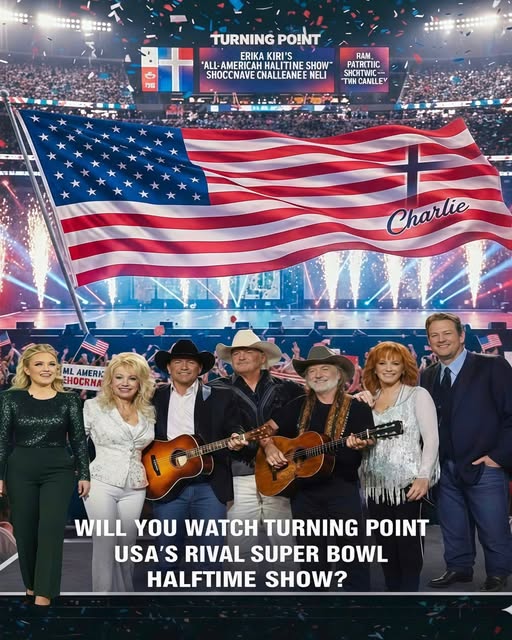
What has fueled the reaction is not simply the idea of alternative programming. Counter-programming during major events is a long-standing practice in television. What makes this rumor feel different, observers say, is how it is being framed. The alleged broadcast is not described as an entertainment alternative or ratings play, but as a statement—one purportedly intended to bypass league approval, avoid corporate sponsorship gloss, and prioritize a message-first approach that Kirk has reportedly characterized as “for Charlie.”
It is crucial to clarify what is known and what is not. As of now, there is no verified confirmation that any network is planning to air a live alternative halftime program during the Super Bowl. There is no confirmation of a broadcast agreement, a live feed, or a scheduled time slot. There is also no evidence of NFL involvement or acknowledgment, and no indication that NBC or any other rights-holding broadcaster has been challenged or displaced. The rumor exists entirely within the realm of online claims and secondhand sourcing.
Despite that, the conversation has intensified. Media analysts note that the claim taps into broader tensions around ownership of attention on major cultural nights. The Super Bowl halftime show has evolved into one of the most tightly controlled media moments in the world, shaped by corporate partnerships, brand safety considerations, and global distribution agreements. Any suggestion of a live, parallel broadcast—especially one framed as independent of those systems—inevitably raises questions about power, permission, and platform.
Supporters of the rumored concept argue that it represents a pushback against homogenization in mass entertainment. They say that a message-first broadcast, even if modest in scale, would offer viewers a choice at a moment when choice is usually constrained. For them, the appeal lies less in production value and more in intention. The idea that a program could run live during halftime without league approval is framed as an assertion of cultural agency rather than a technical challenge.
Critics counter that the claim is implausible and potentially misleading. Live broadcasts at the scale implied require infrastructure, distribution rights, and regulatory coordination that cannot materialize quietly. They caution that framing speculation as imminent reality risks confusing audiences and inflaming divisions without evidence. Media law experts also note that while alternative programming is legal, presenting it as a “competitor” to the Super Bowl halftime risks overstating what would, in practice, be a separate and likely smaller broadcast.
The reported silence from networks has become part of the narrative. Some interpret the lack of response as strategic restraint, a refusal to amplify unverified claims. Others read it as unease, suggesting that even the possibility of a live alternative challenges assumptions about who controls shared cultural moments. Industry veterans, however, emphasize that silence is standard when rumors lack confirmation; networks typically do not comment on speculation.
The phrase “for Charlie” has also drawn scrutiny. Without verified context, its meaning remains interpretive. Commentators have cautioned against reading personal or organizational intent into a phrase that has not been explained publicly. As with other elements of the rumor, the phrase’s ambiguity has allowed audiences to project significance, further fueling debate.
What is striking is how quickly the discussion has polarized. Fans online have begun to frame the scenario as a choice between messages rather than programs, even though no programs have been confirmed. This framing, analysts say, reflects a broader shift in how audiences engage with media: events are increasingly interpreted as symbols, and viewing choices as statements of identity.
From a media economics standpoint, the claim raises practical questions. A live broadcast competing for attention during halftime would need a distribution channel capable of reaching audiences in real time—cable, streaming, or digital platforms with sufficient scale. None have been identified. Without confirmation, experts urge skepticism toward claims of immediate, large-scale impact.
Still, the rumor’s persistence reveals something about the cultural moment. There is evident appetite for alternatives to highly polished, corporate-driven spectacles. Even the idea of an independent, message-first broadcast—whether feasible or not—has captured attention because it speaks to dissatisfaction with uniformity. That dissatisfaction does not guarantee execution, but it does explain engagement.
Sociologists observing the reaction note that major events increasingly function as stages for parallel narratives. Rather than a single shared experience, audiences now encounter layers of commentary, reaction, and alternative content. The rumor of a live All-American Halftime Show fits this pattern, positioning itself—at least rhetorically—as a counterpoint rather than a replacement.
Fact-checkers emphasize the importance of restraint. At present, there is no evidence that any network has agreed to air a live alternative halftime show. There is no verified schedule, no confirmed production details, and no indication that such a broadcast would meaningfully “steal” viewership from the Super Bowl. Claims suggesting otherwise should be treated as speculative.
Yet dismissing the conversation entirely would miss its significance. The intensity of the reaction shows how sensitive the halftime moment has become. It is no longer judged solely on entertainment value, but on what it represents—who is speaking, who is excluded, and who decides. In that context, even unverified claims can spark real debate.
If nothing materializes, the episode will stand as a case study in how quickly narratives can form around major events, driven by emotion and alignment rather than confirmation. If something does materialize—on a smaller scale, through digital platforms—it will likely function less as a competitor and more as a commentary layered alongside the main broadcast.
For now, the responsible conclusion is measured. There is no confirmed live alternative halftime broadcast. There is no confirmed network partner. There is no evidence of a challenge to NBC’s rights or the NFL’s control of the halftime show. What exists is a rumor—and a reaction to that rumor that says a great deal about the current media environment.
Whether or not the All-American Halftime Show ever airs live, the conversation around it underscores a shifting reality. Attention is no longer monopolized by a single channel, and meaning is increasingly contested in real time. The Super Bowl may still own the biggest night in sports—but the debate over who owns the moment has already begun.
Until confirmation arrives, the line between speculation and reality matters. In an era where claims can feel real before they are real, verification remains the most important halftime act of all.