25 MINUTES AGO: MILLIONS ERUPTED — ERIKA KIRK’S MESSAGE IS TEARING AMERICA APART
WHEN FIVE WORDS BECOME A NATIONAL FLASHPOINT
Twenty-five minutes can feel like an eternity on the internet. In that short window, a single line attributed to Erika Kirk—urging people to “turn off the Super Bowl”—has cascaded across platforms, igniting a reaction that feels less like a trend and more like a rupture. Feeds froze. Comment sections flooded. Viewers who expected the familiar rhythm of game-day hype suddenly found themselves pulled into a debate about attention, meaning, and what America’s biggest night is really for.
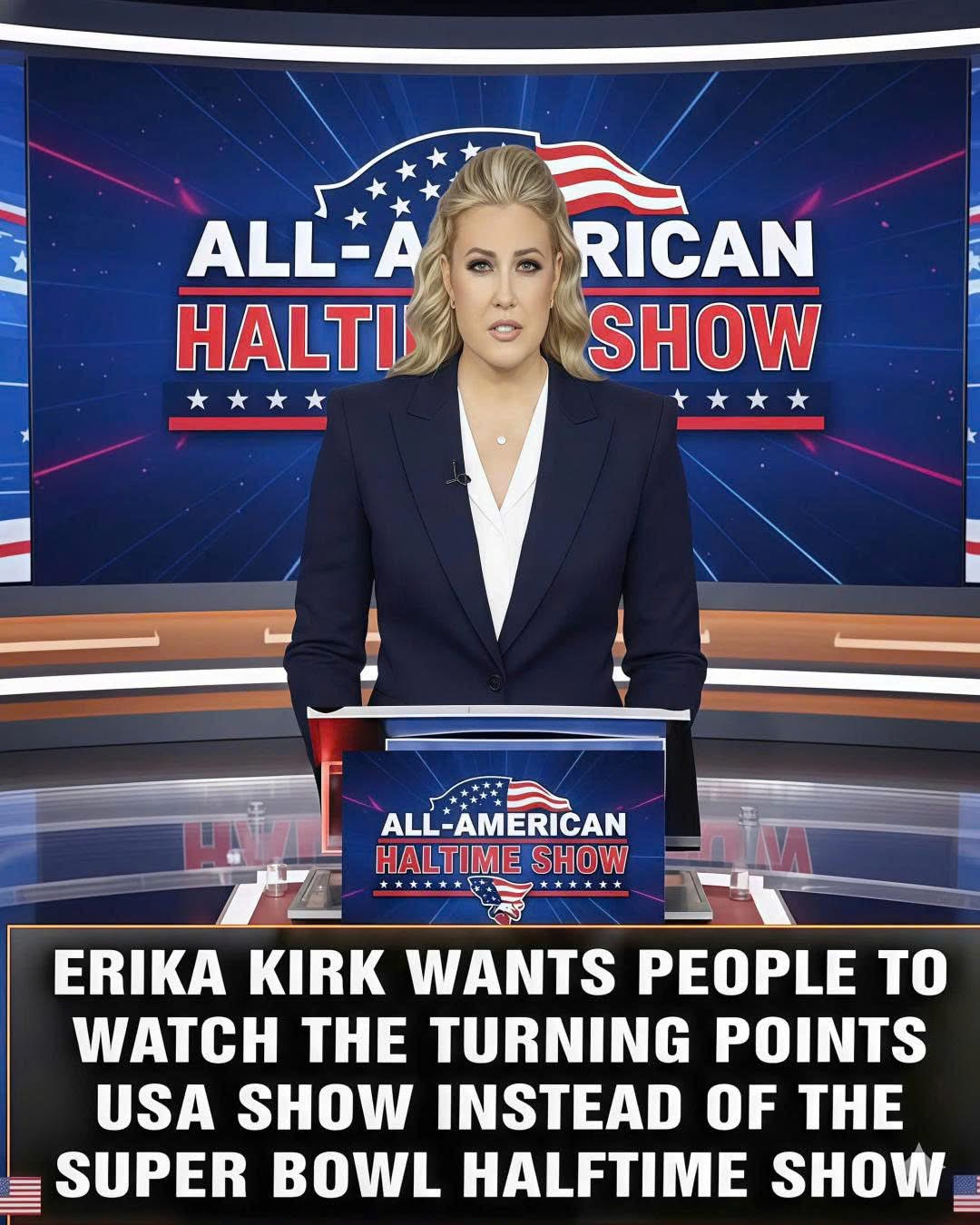
The speed of the response is part of the story. In a media environment saturated with provocation, it takes something unusual to stop the scroll. This did. Not because it was loud, but because it was disruptive in a different way: it challenged a habit. The Super Bowl is not merely watched; it is assumed. It occupies a place on the calendar that rarely needs defending. To question that assumption—publicly and bluntly—cuts against decades of cultural muscle memory.
Within minutes, online communities began to split into recognizable camps. One side greeted the message with applause, reading it as a long-overdue challenge to spectacle and distraction. The other recoiled, accusing it of manufacturing division and undermining one of the few remaining shared rituals. Between those poles, a third group emerged: people who did not necessarily agree, but felt compelled to engage. They admitted, often reluctantly, that the message made them pause.
That pause is the key.
For years, critics of modern media have argued that constant spectacle dulls reflection. The Super Bowl halftime show—arguably the most concentrated dose of spectacle in American entertainment—has often been cited as an emblem of that trend. It is designed to overwhelm, to compress global pop culture into a few dazzling minutes. Supporters celebrate that ambition. Detractors worry about what gets lost beneath the lights.
Kirk’s message reframed that tension as a choice rather than a critique. “Don’t watch” is not a policy proposal; it is a provocation aimed at agency. It asks viewers to consider whether attention is automatic or intentional. And that is what many found unsettling. Habits, once named, become optional—and options invite judgment.
The language circulating around the moment emphasizes this shift. Commentators describe the message not as a boycott, but as a challenge. The distinction matters. A boycott seeks withdrawal to punish. A challenge seeks confrontation to reveal. The framing suggests that what’s at stake is not ratings, but reflection. Not the game itself, but what the game has come to represent.
Supporters argue that the Super Bowl has gradually transformed from a national mirror into a global showcase. In their view, the halftime show increasingly prioritizes international trends and viral aesthetics over domestic cultural resonance. They see the call to “turn off” not as rejection of football, but as resistance to what they perceive as surface-level consumption—entertainment that dazzles without anchoring.
Critics counter that this framing oversimplifies a complex event. The Super Bowl, they argue, has always evolved alongside the country. Its halftime show reflects diversity, experimentation, and generational change. To dismiss it wholesale risks flattening those nuances and turning cultural disagreement into moral judgment.
What both sides acknowledge—often implicitly—is the power of the halftime window. It is one of the last moments in American media that reliably gathers tens of millions of people at the same time. That concentration of attention carries symbolic weight. Challenging it, even rhetorically, feels like challenging the center.
That is why the reaction feels so intense. This is not a debate about a song or an artist. It is a debate about ownership of attention. Who decides where it goes? What obligations come with holding it? And what happens when someone asks viewers to redirect it?
The phrase “look deeper” has become a rallying cry among supporters. They argue that entertainment often functions as anesthesia—soothing discomfort rather than addressing it. By urging people to step away, even briefly, the message forces a reckoning with that role. What are we watching, and why? Are we choosing meaning, or defaulting to habit?
Opponents worry about the implications of that logic. They point out that shared entertainment can also foster connection, offering common ground in a fragmented society. The Super Bowl, imperfect as it may be, still provides a reference point that crosses ideological lines. Undermining that convergence, they argue, risks further isolating audiences into parallel experiences that never intersect.
The discomfort is compounded by ambiguity. Commentators repeatedly reference a “real reason” behind the call—something not fully explained, something hinted at rather than detailed. Ambiguity invites projection. Supporters imagine principled resistance. Critics imagine ulterior motives. In the absence of clarity, narratives multiply.
Media analysts note that this pattern is increasingly common. In an era of instant commentary, incomplete information often travels faster than verification. But they also note that ambiguity can be strategic, whether intentional or not. It keeps attention focused, extends the life of a story, and turns interpretation into participation.
Another reason the moment resonates is its contrast with the usual language of protest. There were no lengthy statements, no policy demands, no elaborate framing. Just five words. Brevity, in this case, functioned as amplification. It stripped away context and forced audiences to supply their own. The result was not consensus, but engagement.
That engagement has taken many forms: think pieces, reaction videos, heated threads, reluctant confessions. Even those who reject the message find themselves articulating why, which is itself a form of reflection. In that sense, the call achieved something rare—it compelled people to explain their relationship to a cultural ritual they usually accept without question.
Industry observers point out that the backlash is not necessarily a failure of messaging. In highly polarized environments, backlash can signal relevance. The fact that people are arguing about attention rather than ignoring the message suggests it struck a nerve. Whether that nerve leads to change or retrenchment remains to be seen.
What complicates the picture further is the timing. Super Bowl week is saturated with anticipation. Ads are teased. Performances speculated upon. The cultural machinery ramps up to full volume. Dropping a message that calls for disengagement at that moment is not accidental. It collides with momentum head-on.
Supporters frame that collision as courage. Critics frame it as sabotage. Both interpretations reveal something about expectations. Many assume that participation is the default and dissent the exception. Challenging that hierarchy flips the script—and flips often provoke resistance.
There is also a generational undercurrent to the debate. Younger audiences, accustomed to choosing between multiple streams and platforms, may view the idea of turning off as unremarkable. Older viewers, for whom the Super Bowl represents continuity and tradition, may experience the suggestion as a threat to shared memory. The same message lands differently depending on lived experience.
As the conversation continues to spread, one thing is clear: the familiar game-day celebration has been interrupted by a question. Not a slogan, not a demand, but a question that lingers. What are we really watching on that screen? And what does our watching endorse?
That question does not require agreement to be effective. It requires attention—and attention, ironically, is what the message is asking people to reconsider.
Whether this moment marks a turning point or fades into the churn of online controversy will depend on what follows. Will the call translate into sustained action, or will it dissolve into another cycle of outrage and counter-outrage? Cultural flashpoints often reveal their significance only in retrospect.
For now, the impact is undeniable. Five words have reframed a national habit as a choice. They have transformed a passive ritual into an active decision. And they have exposed a fault line between spectacle and significance that was already there, waiting to be named.
The unease many feel may stem from that exposure. Once a habit is questioned, returning to it unchanged becomes harder. Even if most viewers tune in as usual, the act will carry new awareness. And awareness, once introduced, is difficult to turn off.
That may be the lasting effect of the moment—not a mass blackout, but a shift in consciousness. A reminder that attention is not neutral, and that choosing where it goes is itself a statement.
Whether one applauds or rejects the message, it has accomplished something rare in modern media: it made millions stop, if only briefly, and think.